Songs After Dark cassette
Never Let Me GoJudy Bridgewater’s Songs After Dark cassette is more than a favorite record in Kathy H.’s recollections: it becomes a container for an intimate fantasy, a troubling encounter with Madame, and Ruth’s effort to repair their friendship. The original disappears at Hailsham, but the meanings Kathy attaches to it persist through the later copy found in Norfolk and the different cassette Ruth gives her as a replacement.
The cassette and its hidden image
The cassette Kathy treasured at Hailsham was an album by Judy Bridgewater, apparently first issued as an LP and recorded in 1956. Its cover showed Bridgewater seated on a bar stool in a purple satin, off-the-shoulder dress, with palm trees and formally dressed waiters behind her. The image suggested a South American setting to Kathy, who described the singer’s look back toward the imagined viewer as friendly and faintly flirtatious. A cigarette burning in Bridgewater’s hand, however, made the cover difficult to display openly.
The Hailsham guardians enforced a strict opposition to smoking. References to cigarettes could interrupt lessons for lectures, and students heard that smoking damaged the body; they also encountered rumors that smoking characters had led to books being kept out of the library, or that smoking images explained missing pages. Kathy therefore turned the cassette cover inside out, so the cigarette would be seen only if someone opened the plastic case. Her secrecy about the cover belonged to the school’s wider awkwardness around subjects the students sensed were important but did not know how to discuss.
The image was not what made the tape precious to her. Kathy did not particularly like Bridgewater’s cocktail-bar style, and the cigarette was not the source of her attachment. What mattered was the album’s third track, Never Let Me Go. Before Walkmans became available at Sales, she could listen most privately in the small six-bed dormitory huts, where a portable cassette player stood on a shelf above the radiator. The billiards room and Art Room players were usually surrounded by other students; in the dorm, she could play her chosen song alone and repeatedly.
The song and Kathy’s imagined child
Kathy kept the tape wound near the song so she could return to its refrain whenever she had the opportunity. At eleven, she did not attend closely to the lyrics as a whole. Instead, the repeated plea to never let someone go called up a story she supplied herself: a woman who had been told she could not have children, who longed for one, and who at last held a baby. In Kathy’s imagined scene, the mother sang from joy but also from fear that the child might become ill or be taken away.
She recognized even then that this interpretation did not fit the rest of the lyrics. The mismatch did not weaken the fantasy; she listened to the song on its own terms, returning to the scene of a mother holding her baby whenever she could be alone. Years later, Kathy would tell Tommy about this private meaning. By then the students had been told clearly that they could not have children, though Kathy explains that she had not properly known this when she first listened. Her childhood interpretation thus gives shape to a longing whose implications she could not yet fully understand.
Madame’s response in the dormitory
One sunny afternoon, Kathy went to the dormitory for something and, finding herself alone, put on the cassette. The player was louder than she usually kept it. As the song played, she swayed with her eyes closed, holding a pillow as though it were a baby and softly singing along. Near the end of the track, she opened her eyes and saw Madame standing in the corridor, watching through the partly open doorway.
Madame had not crossed the threshold. She stood very still, looking in, and was crying. Kathy froze, then became alarmed by the adult’s distress and by the familiar strangeness of Madame’s gaze. Instead of entering or addressing her, Madame turned away and hurried toward the main house, still sobbing. Kathy switched off the cassette and sat on the nearest bed. She told no one what had happened, wishing the episode had not occurred rather than risk making it a subject of discussion.
A couple of years later, after Kathy had told Tommy about the scene, he proposed that Madame had understood the pillow as a baby and felt the tragedy of Kathy’s inability to have children. Kathy pointed out that Madame could not have known what the song meant to her or what the pillow represented, since both meanings had been in Kathy’s mind. Tommy half-jokingly suggested that Madame might be able to read minds. They shared a chill and laughed, but the explanation remained a speculation between them, not a confirmed account of Madame’s thoughts. The scene’s force lies partly in that uncertainty: Kathy’s private fantasy, the students’ unspoken condition, and an adult’s tears occupy the same doorway without becoming a conversation.
Disappearance and Ruth’s replacement
A couple of months after the encounter, the original cassette vanished from Kathy’s collection chest. She noticed it while searching before lights-out and tried not to let her panic show, humming as she rummaged. Even among her closest friends, she concealed how much the loss hurt. Kathy later associated that guardedness with the private fears and longings the students kept to themselves, needs that seemed somehow shameful to acknowledge. She asked the others casually whether they had seen the tape, hoping it might have been left in the billiards room or borrowed and returned the next morning. It never appeared, and she never learned what had happened to it. She suspected that theft at Hailsham was more common than either students or guardians wanted to admit, but explicitly saw no reason to connect this disappearance with Madame’s visit.
Ruth had reason to notice the depth of Kathy’s distress. Less than a month earlier, Kathy had intervened when Midge questioned Ruth about her pencil case; since then, Ruth had been looking for a chance to do something kind in return. On the night the tape went missing, Ruth responded with an apparently distracted shrug, but the next morning Kathy heard her casually asking Hannah whether she had seen it. Ruth had understood both that the cassette mattered and that Kathy did not want a fuss made about it.
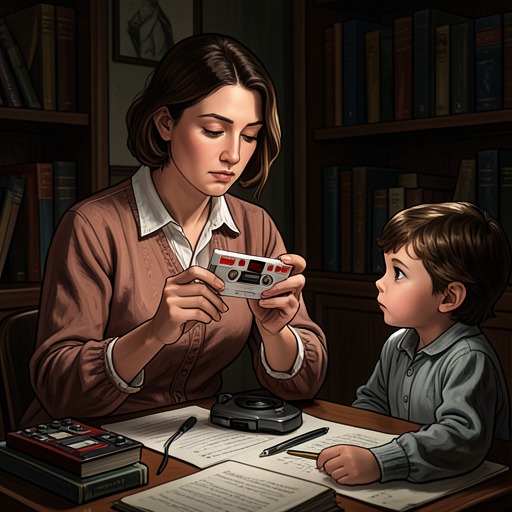
About a fortnight later, when Kathy had accepted that the tape was gone, Ruth found her during lunch and asked her to walk. They went from the grass to the edge of the North Playing Field and up the north hill, where Ruth handed her a small bag containing another cassette. Ruth immediately made clear that it was not the lost one: she had tried to find the original, but it was really gone. Kathy answered that it had gone to Norfolk, invoking the students’ shared joke that lost precious things might be found there. They laughed, though Kathy’s disappointment was still visible as she examined Ruth’s gift, Twenty Classic Dance Tunes, an orchestral collection for ballroom dancing.
The replacement was not musically similar to Bridgewater’s album, and Ruth did not know enough about Kathy’s musical tastes to choose an equivalent. Once Kathy recognized the mismatch, however, her disappointment gave way to happiness at the care behind the gift. The two did not often hug at Hailsham; instead, Kathy squeezed one of Ruth’s hands between both of hers as she thanked her. She told Ruth the tape was exactly the sort of thing she liked, accepting the gesture as well as the object. Kathy recalls the exchange as a point after which their friendship began to feel normal again.
Copies, memory, and lasting value
The objects connected with the loss are distinct. Ruth’s Twenty Classic Dance Tunes was a substitute gift, not a recovered copy of the album. Years later, Kathy and Tommy found another copy of Judy Bridgewater’s album in a town on the Norfolk coast. Kathy’s present-day copy is that later discovery, not the cassette she owned and lost at Hailsham. The Norfolk find amused them, but also stirred an old wish to believe that something precious could be recovered there. Norfolk’s importance in this memory is emotional rather than practical: it had offered the students comfort when they could not find what they had lost.
Kathy still keeps Ruth’s replacement, though she rarely plays it because its music has little personal significance. She values it as an object, like a brooch or ring, and especially after Ruth is gone it remains one of her most precious possessions. The later Norfolk copy of the original album also matters to her, but it cannot make the first cassette reappear or erase the circumstances of its loss. At the time of her recollection, Kathy sometimes listens to the copy while driving in the open country on a drizzly day; the car’s unreliable cassette player and her lack of time in her bedsit make listening difficult. She hopes that when she is no longer a carer she will have more time for it. Across these separate tapes, the album survives less as a piece of music than as a route back to a childhood fantasy, a silence shared with Tommy, and Ruth’s unshowy attempt to give something precious back.